


Which Lead Is Right for Your Dog?
Walk into any pet shop and the lead wall alone can be overwhelming—standard leads, slip leads, retractables, bungee leads, training lines, and more, all claiming to be the answer. The truth is, no single lead is "best." Each type suits a different dog, situation, or stage of training.
This guide breaks down every major type of dog lead, exactly what it's built for, and how to work out which one actually fits your dog's needs.
At a Glance
| Lead Type | Best For |
|---|---|
| Standard/Fixed Lead | Everyday walks, general use |
| Bungee/Shock-Absorbing Lead | Dogs that pull, active walkers and runners |
| Slip Lead | Quick control situations, vet visits, rescue/shelter settings |
| Retractable Lead | Very open, low-distraction spaces only |
| Training/Long Line | Recall training, distance work |
| Multi-Dog Coupler | Walking two dogs at once |
Jump to Section
- Standard/fixed leads
- Bungee/shock-absorbing leads
- Slip leads
- Retractable leads
- Training/long lines
- Multi-dog couplers
- How to choose the right lead
- Common mistakes to avoid
- Recommended leads
- FAQs
Standard/Fixed Leads
The classic lead most owners start with: a fixed length of webbing, leather, or rope with a clip at one end and a handle at the other, typically around 1.2–1.8 metres.
| Pros | Cons |
|---|---|
| Simple, reliable, predictable length | No shock absorption for dogs that pull hard |
| Widely suitable for most dogs and situations | Less versatile than double-ended designs |
| Available in premium materials for durability | — |
This is the right default for calm walkers, well-trained dogs, and everyday use where you don't need extra features.
Bungee/Shock-Absorbing Leads
These leads incorporate an elasticated section that absorbs sudden lunges or pulls, reducing jolt on both your arm and your dog's neck or chest.
| Pros | Cons |
|---|---|
| Reduces strain from pulling for both dog and owner | Slightly heavier/bulkier than a basic lead |
| Often double-ended with multiple attachment points | Not necessary for dogs that already walk calmly |
| Many include reflective detailing and traffic handles for extra control near roads | — |
A traffic handle—a shorter secondary grip closer to the clip—gives you much tighter control in busy areas without needing to shorten the entire lead. It's one of the most underused features on a modern lead.
Slip Leads
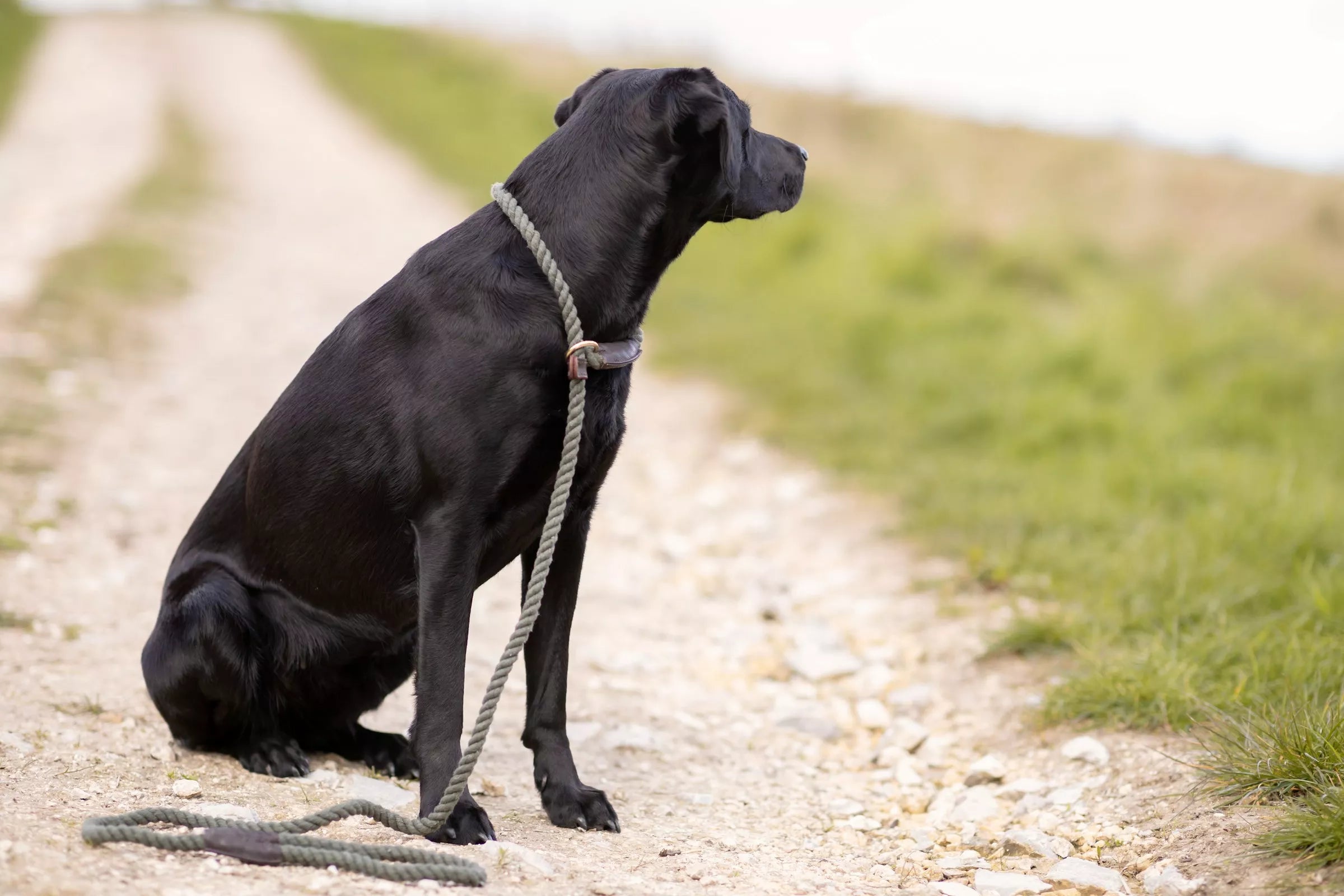
A slip lead combines a collar and lead in one continuous loop, tightening gently when a dog pulls and loosening when they stop. No separate collar is needed.
| Pros | Cons |
|---|---|
| Extremely quick to put on and take off | Can tighten too much if a dog pulls persistently |
| Useful for vet visits, groomers, or emergency control | Not designed for dogs with breathing sensitivities |
| Common in rescue and shelter settings for fast handling | Not ideal as an everyday walking lead for most pets |
Slip leads work best as a backup or specific-situation tool rather than a daily walking lead—particularly for dogs where a harness and standard lead is the safer everyday choice.
Retractable Leads
Retractable leads are one of the most commonly flagged safety concerns by vets and trainers. The thin cord can cause serious rope burns or lacerations, and the mechanism gives far less immediate control than a fixed-length lead—particularly risky near roads, other dogs, or wildlife.
| Pros | Cons |
|---|---|
| Allows more roaming room in wide open spaces | Slower to reel in during an emergency |
| Can suit very calm, well-trained dogs in low-risk areas | Higher injury risk to hands and legs (owner and dog) |
| — | Not suitable near roads, cyclists, or other dogs |
If used at all, retractable leads are best reserved for large, enclosed, distraction-free spaces—not as a general-purpose lead.
Training/Long Lines
A long line—typically 5 to 15 metres—gives a dog freedom to explore and practise recall at a distance, while remaining safely attached.
| Pros | Cons |
|---|---|
| Ideal for recall training in open, safe areas | Requires practice to manage without tangling |
| Builds independence without losing control | Not suitable for busy or narrow spaces |
When starting long-line training, let some slack drag on the ground rather than holding it taut—this lets you step on the line quickly if needed, without your dog constantly feeling lead pressure.
Multi-Dog Couplers
A coupler splits into two leads from a single handle, letting one person walk two dogs simultaneously.
| Pros | Cons |
|---|---|
| Frees up a hand compared to holding two separate leads | Not suitable if the two dogs have very different paces or pulling styles |
| Works well for dogs that already walk well together | Can transfer one dog's sudden movement to the other |
How to Choose the Right Lead
| Your Situation | Recommended Lead |
|---|---|
| Calm, well-trained dog, everyday walks | Standard/fixed lead |
| Dog that pulls or lunges | Bungee/shock-absorbing lead |
| Fast handling needed (vet, groomer, rescue) | Slip lead |
| Recall or distance training | Training/long line |
| Walking two dogs together | Coupler (if paces are well matched) |
| Busy streets, near roads or cyclists | Standard or bungee lead with a traffic handle—avoid retractables |
If pulling is your main issue, pairing the right lead with the right harness makes the biggest difference—our guide on Y-shaped harnesses covers why this combination tends to work best.
Common Mistakes to Avoid
| Mistake | Better Approach |
|---|---|
| Using a retractable lead near roads or other dogs | Switch to a fixed-length lead in any higher-risk environment |
| Using a slip lead as a full-time everyday lead | Reserve slip leads for quick, specific situations |
| Choosing a lead based on looks alone | Match the lead type to your dog's behaviour and your environment |
| Ignoring wear and tear on clips or stitching | Check hardware regularly, especially on leads used daily |
Recommended Leads
Artisan Leash
A refined standard lead in durable nylon webbing with leather accents and a brassed clasp—built for everyday walks that still look the part.
Heavy Duty Bungee Leash
Featuring a 360° rotating clip, shock-absorbing bungee section, dual traffic and walking handles, and reflective detailing for low-light visibility.
Cordura® Zip-Pocket Leash
A durable Cordura® lead with a built-in zip pocket—useful for carrying waste bags or treats without a separate pouch.
Explore the Zip-Pocket Leash →
Continue Learning
- Why Y-Shaped Dog Harnesses Are Better
- Can Pulling Damage a Dog's Shoulders?
- Shop All Leads
- Shop Double-Ended Leads
Frequently Asked Questions
What's the safest type of dog lead?
For most everyday situations, a standard or bungee lead with a secure clip and, ideally, a traffic handle offers the best combination of control and safety.
Are retractable leads bad for dogs?
They're not inherently dangerous in the right setting, but vets and trainers frequently flag them for injury risk and reduced control—best limited to open, low-distraction spaces.
What is a slip lead used for?
Slip leads combine a collar and lead in one, and are popular for quick handling situations like vet visits or shelters—less suited to everyday walking.
Do bungee leads actually help with pulling?
Yes, to a degree. They absorb sudden force rather than eliminating pulling entirely, making walks more comfortable while you work on lead training separately.
What length lead should I use?
Around 1.2–1.8 metres suits most everyday walking. Longer training lines (5+ metres) are for recall and distance work in open spaces, not general walking.
Can I use one lead to walk two dogs?
Yes, with a coupler—but only if both dogs walk at a similar pace and don't pull unpredictably, since a coupler transfers movement between them.
Share:
How Long Can a Dog Travel in a Car? (Break Times Guide)